
Bark Scorpion Control in Phoenix, AZ
- Pest Control Service in Phoenix
- Scorpion Exclusion and Sealing
- Subterranean Termite Treatment
- Drywood Termite Treatment
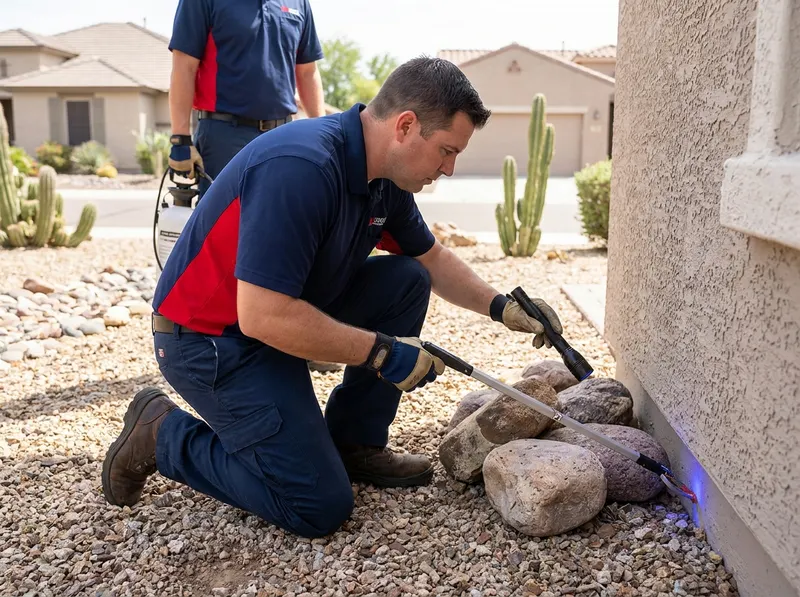
- What's included: a walk of the full exterior perimeter and yard, treatment of block-wall bases, weep screeds, irrigation and valve boxes, and rock or bark landscaping, plus interior treatment of garage walls, plumbing penetrations and closet corners.
- How fast: most Phoenix homes are scheduled within 1 to 3 business days, and a standard single-family visit takes 45 to 90 minutes depending on lot size and block-wall footage.
- What it costs: an initial bark scorpion service in Phoenix runs about $250 to $425 for a typical single-family home; larger desert-edge lots and exclusion work price higher. Minimum charge is $250.
- What we take: cash, card, and electronic payment, with the price confirmed in writing before any product is applied.
- How to book: call (520) 677-4082 to describe where you saw the scorpion and get a free on-site visit that confirms the exact price.
<p>Bark scorpions are climbers, and that changes everything about how a Phoenix home has to be treated. Unlike the desert hairy scorpion, <strong>Centruroides sculpturatus climbs vertical stucco, block walls and tile roof edges</strong>, which is why homeowners in Desert Ridge and Deer Valley find them on a bedroom wall or in a second-story shower rather than on the floor by the door. Newer stucco construction across those areas has <strong>weep screed at the base of the wall</strong> — a functional drainage gap that is also a direct path into the wall cavity. In Willo Historic District, Encanto-Palmcroft and Coronado Historic District the entry points look different: settled brick and block foundations, original single-pane window frames, and detached garages with wide door sweeps. Either way, the scorpion did not come in because the house is dirty. It came in because a gap the width of a credit card was available.</p><p>Harborage is the second half of the picture. Bark scorpions shelter in the hollow cores and mortar seams of <strong>block walls</strong>, under decorative granite, in irrigation and valve boxes, in stacked pavers, and in the woodpile against the fence. Ahwatukee Foothills and Sunnyslope properties that back to South Mountain Park and Preserve or the slopes near Piestewa Peak sit against a continuous natural population, so treatment there is about maintaining a defended band around the structure rather than clearing a neighborhood. In Arcadia and Laveen, flood irrigation drives scorpions and their prey upward and outward on schedule — activity typically spikes in the days after a flood cycle, and again after monsoon storms in July and August. Maryvale's mature alleys and shared block walls tend to produce steady, low-level pressure from multiple directions at once.</p><p>Decision-fit is straightforward. If you have seen one scorpion, once, and you have a hard slab and no block wall, a single service visit plus sealing the specific entry point is a reasonable place to start. If you have seen scorpions <strong>more than twice, or anywhere above the floor, or in a bedroom</strong>, treat that as an established population and plan on a recurring exterior program — the honest trade-off is that recurring service costs more over a year but is the only approach that keeps pressure down, while one-off visits are cheaper and typically fade in three to six weeks. Homes with small children, or with someone who has had a reaction to a sting, should default to the program plus exclusion. We apply products according to label directions, and we tell you what was used, where, and what to keep pets and kids off of and for how long — ask before the visit if you have a vegetable garden or an outdoor dog run so placement can be adjusted.</p><p>Every visit is documented: what we found, where we treated, which gaps we sealed, and what still needs attention. That record matters for landlords in Maryvale and Laveen who need to show a tenant what was done, and it matters for you at visit three, when the question is whether activity is actually dropping. One limit stated plainly: <strong>no first visit eliminates an established bark scorpion population</strong>, because eggs, juveniles and wall-void individuals are not contacted by a single application. Reduction is measured over 60 to 90 days. Call (520) 677-4082 to get on the schedule.</p>
Call (520) 677-4082Bark Scorpion Control pricing in Phoenix
| Initial bark scorpion service, typical Phoenix single-family home (interior + exterior + block-wall line) | $250 – $425 |
| Large or desert-edge lot (Ahwatukee Foothills, Sunnyslope, hillside properties) | $325 – $575 |
| Follow-up service in the first 60–90 days | $250 – $350 per visit |
| Recurring exterior scorpion program | from $250 per visit, frequency set on-site |
| Night UV inspection with written findings and photo documentation | $250 – $375 |
| Exclusion work: weep screed screening, garage door sweeps, plumbing and roofline gap sealing | $275 – $850 depending on linear footage |
Exact price confirmed free on-site before any work.
Bark Scorpion Control — questions, answered
How many treatments does bark scorpion control in Phoenix usually take?
Plan on an initial service plus at least two follow-ups over 60 to 90 days for an established Phoenix population. Bark scorpions shelter deep in block-wall cores and wall voids where a single application does not reach every individual, so reduction is measured across visits rather than after one.
Why do I still see scorpions in my Phoenix home after a spray?
Seeing scorpions after a treatment is normal in Phoenix and often means the product is working — disturbed and dying scorpions move into the open. Continued sightings past the first few weeks usually point to an untreated harborage such as a block wall, irrigation box or granite bed, or an open entry point like weep screed or a worn garage door sweep.
Are Phoenix bark scorpion treatments safe around dogs, kids and a vegetable garden?
Products are applied per label directions, with placement adjusted for pets, children and edible plants — tell us before the Phoenix visit where the dog run and garden beds are. You will be told exactly what was used, where it was applied, and how long to stay off treated surfaces; nothing is applied over vegetables.
Do I have to sign a year-long contract for scorpion service in Phoenix?
No. A one-time bark scorpion service in Phoenix is available, and the recurring program is recommended, not required. For homes backing to open desert near South Mountain Park and Preserve or Piestewa Peak, recurring exterior service is the realistic option because the surrounding population is continuous.
When are bark scorpions most active in Phoenix?
Bark scorpion activity in Phoenix peaks from roughly April through October, with sharp spikes during monsoon storms in July and August and in the days after flood irrigation cycles in areas like Arcadia and Laveen. Scorpions remain present in winter but move less, which makes the cooler months a good window for exclusion work before spring activity resumes.