
Drywood Termite Treatment in Phoenix, AZ
- Pest Control Service in Phoenix
- Bark Scorpion Control
- Scorpion Exclusion and Sealing
- Subterranean Termite Treatment
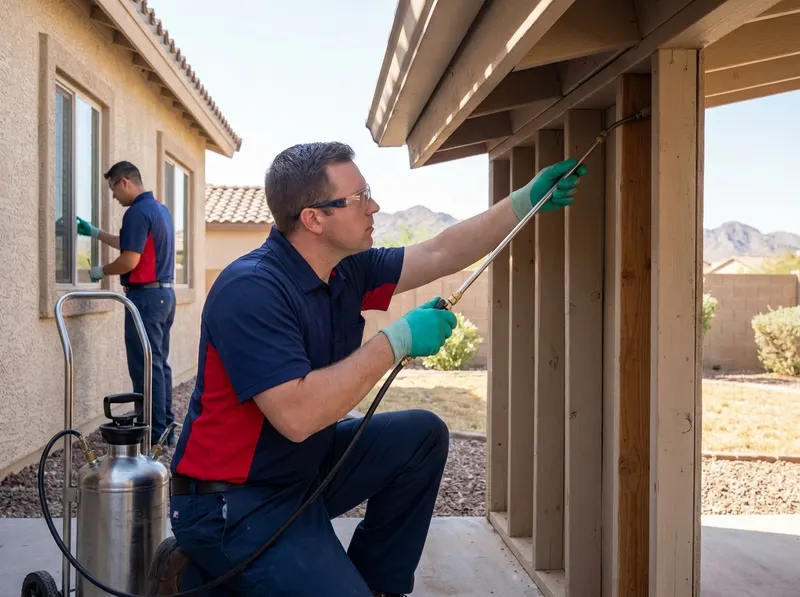
- Included: full inspection of accessible wood members, identification of the pellets and kick-out holes, mapping of active galleries, drill-and-inject treatment of the infested wood, and written documentation of every area treated.
- Speed: most localized drywood termite treatments in Phoenix are finished in a single visit of roughly one to three hours, and inspections are usually scheduled within a few days of the call.
- Cost: <strong>$250 is the minimum charge</strong> for drywood termite work; localized treatment of one to several areas commonly falls in the $250–$900 range, and whole-structure fumigation runs well into four figures. These are ballparks — the exact price is confirmed on a free on-site visit.
- What we take: card and check are standard payment options, confirmed when the appointment is booked; payment is due once the treated areas are documented.
- Booking: call (520) 677-4082 with the location of the pellets or holes — garage door frame, window sill, attic, patio beam — and we schedule an inspection at the address.
Drywood termites announce themselves with small piles of hard, six-sided fecal pellets about the size of coarse pepper, usually sitting on a window sill, a garage floor, or the concrete under a patio beam. The pellets fall from tiny round kick-out holes the colony keeps open. That evidence points to drywood termites and rules out subterranean species, which build mud tubes up block walls and stucco instead. Getting that identification right decides the entire treatment, because a soil trench and termiticide barrier — correct for subterranean colonies — does nothing to a colony sealed inside a header above a doorway.
Localized injection fits when the activity is confined and reachable. That covers most of what we see: a single door frame, a window sash, a run of fascia, a garage jamb, an exposed rafter tail. Small holes are drilled into the galleries, product is injected through the tunnel network, and the holes are patched. The trade-off is honest and worth stating plainly — <strong>localized treatment protects the wood it reaches, not the wood it does not</strong>. When galleries run through inaccessible framing, or when three or four separate areas are active in different parts of the house, whole-structure fumigation becomes the option that treats everything at once, at a much higher cost and with two to three days out of the home. We will tell you which category your house is in rather than upselling the larger job by default.
Phoenix housing stock shapes where drywood termites turn up. The 1920s and 1930s bungalows in the Willo Historic District, Coronado Historic District and Encanto-Palmcroft have exposed rafter tails, wood porch columns and original double-hung sashes — all dry, all decades old, all reachable by desert drywood termites without ever touching soil. Mid-century Maryvale and Sunnyslope homes tend to show activity in wood window frames and garage door surrounds. In Arcadia, Ahwatukee Foothills, Desert Ridge, Deer Valley and Laveen, the calls usually come from patio ramadas, shade structures, wood trellises and attic framing. Winged swarmers commonly appear around porch lights and pool lights on late-summer and fall evenings across Maricopa County, and a handful of shed wings on a windowsill is often the first sign a homeowner notices.
Safety questions get a direct answer. Injection is placed inside the wood member, not broadcast across floors, yards or vegetable beds, which is one reason it suits households with dogs, kids and backyard gardens near South Mountain Park and Preserve or the Papago Park corridor. Fumigation, by contrast, requires the structure to be vacated and food to be removed or double-bagged, and every requirement is explained in writing before anything is scheduled. Damaged structural members sometimes need carpentry replacement — that work is separate from treatment and is called out in the inspection notes so you are not surprised. <strong>Drywood termite work here is one-time treatment, not a mandatory annual contract</strong>, and every hole drilled and area treated is documented so you have a record for your file, an HOA, or a buyer's agent. Call (520) 677-4082 to get the wood looked at.
Call (520) 677-4082Drywood Termite Treatment pricing in Phoenix
| Drywood termite inspection with written findings | $250 minimum (credited toward treatment) |
| Localized drill-and-inject, one area (door frame, window sash, single beam) | $250 – $450 |
| Localized treatment, multiple active areas | $450 – $900 |
| Attic or roof framing treatment (accessible members) | $600 – $1,500 |
| Whole-structure fumigation (tenting), typical Phoenix home | $1,800 – $4,500+ |
| Follow-up re-inspection of treated wood | From $250 |
Exact price confirmed free on-site before any work.
Drywood Termite Treatment — questions, answered
How do I tell drywood termites from subterranean termites in a Phoenix home?
Drywood termites in Phoenix leave dry, six-sided pellets and small round kick-out holes in the wood itself, with no soil contact. Subterranean termites leave mud tubes and mud-packed cracks running up block walls, stucco and garage baseboards. The pellet test is the fastest field check, and the identification determines whether the treatment goes into the wood or into the soil.
Does drywood termite treatment in Phoenix always require tenting the house?
No. Most drywood termite jobs in Phoenix are handled with localized injection into the infested galleries, because the activity is confined to reachable wood such as a door jamb, window sill, fascia run or patio beam. Whole-structure fumigation is reserved for infestations spread through framing that cannot be accessed, and that recommendation is explained before anything is scheduled.
What does drywood termite treatment cost in Phoenix?
Drywood termite treatment in Phoenix starts at a $250 minimum, with single-area localized injection commonly in the $250–$450 range and multi-area work in the $450–$900 range. Whole-structure fumigation is a four-figure job. All figures are ballparks; the exact price is confirmed on a free on-site visit once the active areas are located.
Are the older homes in Willo and Coronado Historic District in Phoenix more prone to drywood termites?
Older Phoenix neighborhoods including Willo Historic District, Coronado Historic District and Encanto-Palmcroft see drywood termite activity often because of exposed rafter tails, original wood window sashes and wood porch elements that have been dry and undisturbed for decades. Drywood termites need no soil moisture, so an immaculate, well-kept historic home is still a candidate.
Will one drywood termite treatment in Phoenix protect the whole house?
One localized drywood termite treatment in Phoenix protects the wood members that were injected, not untreated wood elsewhere in the structure. A separate colony can establish in a different beam or frame later, which is why the treated areas are documented and a re-inspection is offered. Only whole-structure fumigation addresses the entire building at once.