
Termite Inspection and Written Report in Phoenix, AZ
- Pest Control Service in Phoenix
- Bark Scorpion Control
- Scorpion Exclusion and Sealing
- Subterranean Termite Treatment
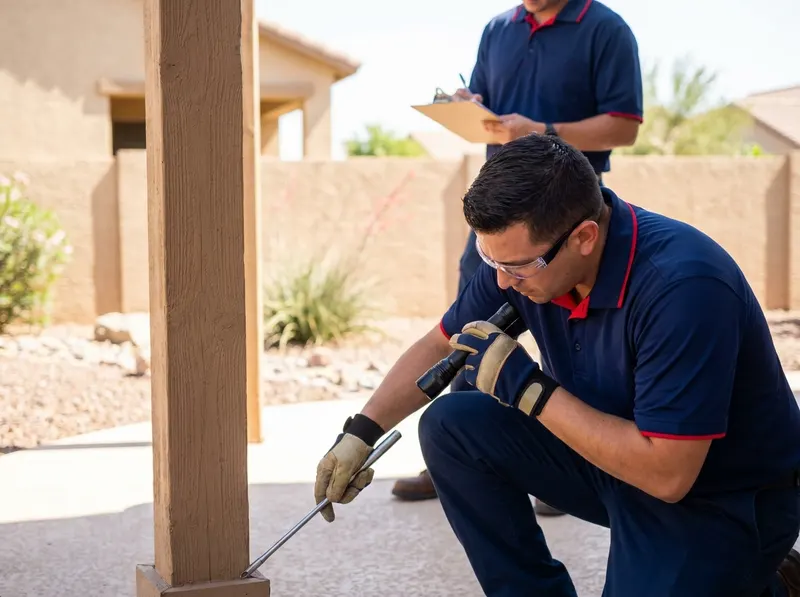
- Included: exterior slab perimeter and weep screed check, garage baseboards and expansion joints, plumbing penetrations, water heater and under-sink cabinets, accessible attic and roof sheathing, block walls and fence lines, plus a written report with findings, locations and recommendations.
- Timing: most single-family Phoenix inspections take 45 to 90 minutes on site, and the written report is typically issued within one business day so escrow timelines are not held up.
- Cost: a termite inspection with written report in Phoenix generally runs $250 to $500 depending on square footage, foundation type and access — $250 is the minimum charge.
- What the report covers: visible and accessible areas only, on the date of inspection; no report can certify that a Phoenix home will stay termite-free afterward.
- Booking: call (520) 677-4082 with the address, approximate square footage and your deadline date, and the exact inspection price is confirmed on the phone before anything is scheduled.
An inspection-first approach fits three situations in Phoenix. First, a signed home-sale contract where the lender, buyer or title company wants a wood-destroying insect report in the file before closing. Second, a home where something was spotted — a mud tube on the garage baseboard, a pencil-thin dirt line up a block wall, small holes in a door jamb — and you need to know the extent before spending money on treatment. Third, an HOA or property-management request for documentation on a rental. If you already have confirmed active termites and no deadline, paying for an inspection separately is often the wrong order of operations; the sensible move there is a treatment evaluation. <strong>The trade-off is simple: an inspection buys documentation and a map of the problem, not protection.</strong>
What gets checked depends heavily on how and where the house was built, and Phoenix has several very different housing stocks. Flood-irrigated lots in Arcadia and Encanto-Palmcroft keep soil moisture high against foundations for days after a turn, so the perimeter, planter beds and any wood in contact with grade get close attention. Homes in Willo Historic District and Coronado Historic District often have raised wood floors, subfloor crawl areas and original door frames — different evidence, different access questions, and sometimes drywood termite pellets rather than mud tubes. The 1950s block-and-slab houses across Maryvale and parts of Sunnyslope hide activity at expansion joints and behind stucco weep screeds, which is the single most common entry route we document in Maricopa County. Newer slab construction in Desert Ridge, Laveen and Deer Valley brings tight side yards, buried utility penetrations and irrigation heads spraying the stem wall. Ahwatukee Foothills properties backing to South Mountain Park and Preserve sit near natural desert wood debris and dead cactus, which is native forage for the desert subterranean termite long before it reaches a house.
<strong>The written report states findings, locations, conditions conducive to infestation, and evidence of prior treatment where visible.</strong> It notes areas that could not be inspected — a full attic with blown insulation, a finished garage wall, stored boxes against a baseboard — because an honest report names its own blind spots instead of implying a whole-house guarantee. Probing or opening finished surfaces is only done with the owner's permission. <strong>Desert subterranean termites forage year-round in Phoenix soils, and swarms are most visible in the evenings after monsoon rain</strong>, so a clean report in May and activity in August are not a contradiction — they are two different dates. That candor is deliberate: the report is meant to survive a second opinion.
Drywood termites and subterranean termites call for different responses, and the report says which one the evidence points to rather than defaulting to whichever treatment is easiest to sell. If treatment is recommended, the report explains what that treatment would actually accomplish and what it would not. <strong>Photos of findings are included so a buyer, seller or agent 2,000 miles away can see the same mud tube the inspector saw.</strong> To schedule around a closing date, an HOA letter deadline or a refinance, call <strong>(520) 677-4082</strong> with the property address and the date the report is due.
Call (520) 677-4082Termite Inspection and Written Report pricing in Phoenix
| Standard termite inspection + written report, single-family home under ~2,500 sq ft (Maryvale, Laveen, Deer Valley) | $250 - $375 |
| Larger home or added structures - detached garage, casita, guest house inspected same visit (Arcadia, Desert Ridge) | $325 - $500 |
| Historic raised-foundation home with subfloor or crawl access (Willo, Coronado Historic District) | $300 - $475 |
| Re-inspection and follow-up written report after corrective treatment | $250 - $325 |
| Duplex or small rental property, per building, scheduled together | $250 - $450 |
Exact price confirmed free on-site before any work.
Termite Inspection and Written Report — questions, answered
How much does a termite inspection with a written report cost in Phoenix?
Most Phoenix termite inspections with a written report fall in the $250 to $500 range, with $250 as the minimum charge. Square footage, foundation type, number of structures and how accessible the attic and perimeter are drive where a specific property lands. The exact figure is confirmed on the phone before scheduling, not after the visit.