 Byte Pest Control ServiceByte Pest Control Service
Scorpions out. Every treatment documented.
Pest control service Phoenix homeowners actually need starts with naming the pest and finding where it lives, not with a coupon price. A bark scorpion on a bedroom wall at 11 p.m., mud tubes on a garage baseboard in Arcadia, or roaches in a Maryvale kitchen three days after a monsoon storm are three different problems with three different treatments, and treating them the same way is why one-off sprays stop working by week six. Every visit gets written up — what was found, where it was treated, what still needs sealing — and you can call (520) 677-4082 or text a photo of the pest for a straight answer before anyone comes out.
Call (520) 677-4082
Text or call about your pest control service job — a quick photo helps us quote fast.
A firm, all-in price confirmed before we start — no surprises.
On time, done to standard, and tidy when we leave.
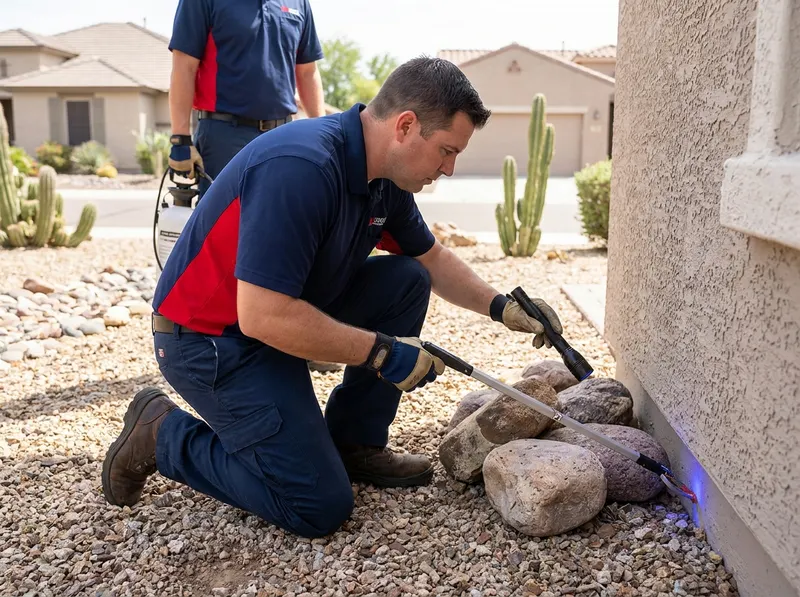
Bark scorpion service in Phoenix targets harborage, not open floor space. The visit covers interior baseboards, closets and bathrooms, then the exterior perimeter: weep screeds along the stucco, block-wall bases, decorative rock, pool equipment pads, irrigation boxes and the garage threshold. Bark scorpions are the one Arizona species with venom capable of serious reaction, they glow under UV light, and they hunt at night from mid-spring through October. Expect an initial service plus recurring exterior visits — an established population near desert edge in Ahwatukee Foothills or below Camelback Mountain does not clear in one appointment, and you will be told that plainly rather than sold a single spray.
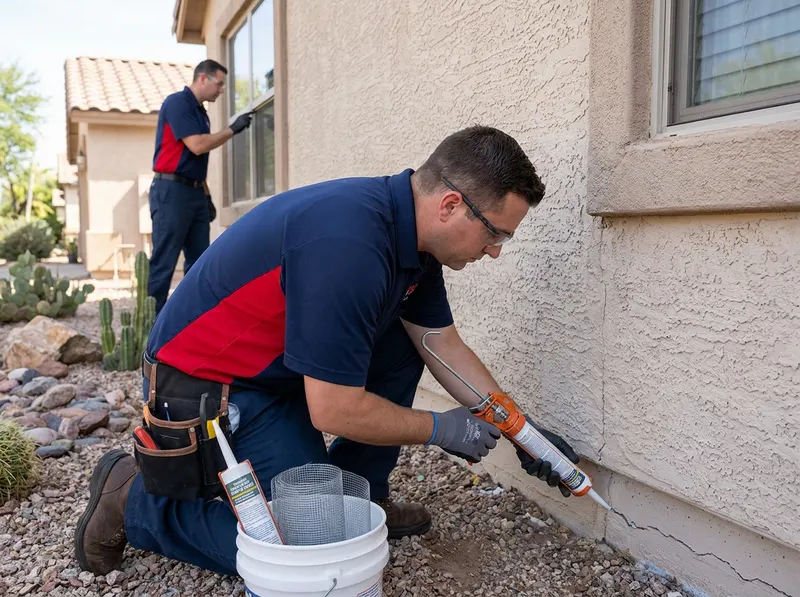
Scorpion exclusion is the physical work that keeps scorpions out of Phoenix houses after the treatment has weathered. Weep screeds get screened, door sweeps and garage corner gaps get closed, plumbing and A/C-line penetrations get sealed, and the seam where a patio roof meets stucco gets checked, because a scorpion can pass a gap narrower than a sixteenth of an inch. Exclusion matters most in homes with block-wall yards, stem-wall stucco and attached garages — the standard build across Deer Valley, Desert Ridge and Laveen. Priced by the amount of gap actually found and quoted on-site before work starts.
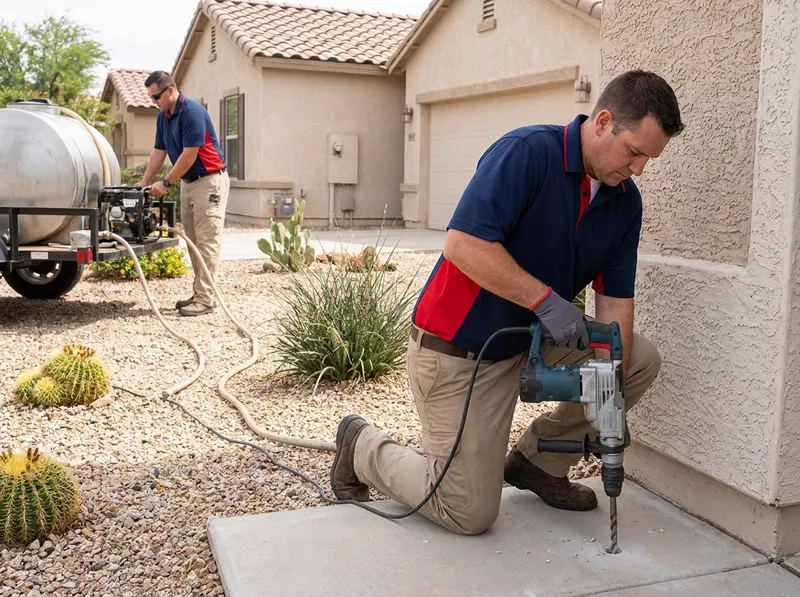
Subterranean termites reach Phoenix homes from the soil through slab cracks, expansion joints, plumbing penetrations and stem walls, and they announce themselves as mud tubes on garage baseboards, patio piers and interior drywall. Treatment is either localized to the active area or a full perimeter trench-and-treat barrier applied around the foundation footprint. Flood-irrigated lots and long-established landscaping in Arcadia, Encanto-Palmcroft and Coronado Historic District keep soil moisture high, which is exactly the condition subterranean colonies want. Every treated point, drill location and product used is documented so you have a record for an HOA, a lender or the next buyer.
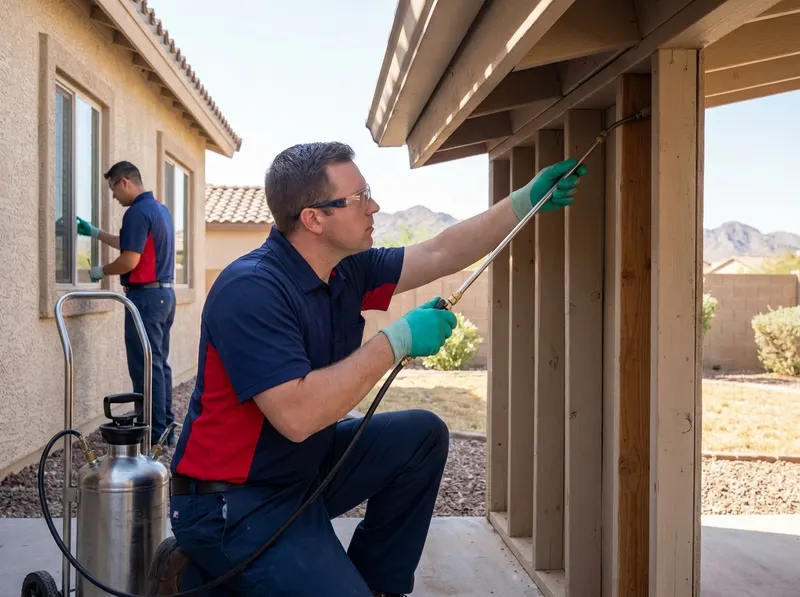
Drywood termites live inside the wood itself, so soil barriers do nothing for them. In Phoenix they show up in fascia, door jambs, patio beams, window frames and stored lumber, and the tell is small pellet-like frass collecting on a sill or garage floor rather than mud tubes. Treatment is localized to the infested member — the wood is probed to map the gallery, treated directly, and the surrounding members are checked for spread. Swarmers typically appear after warm rain, which is why late-summer calls cluster in older wood-trimmed homes in Willo Historic District and Sunnyslope. Badly damaged wood needs a carpenter; that is said up front, not after.
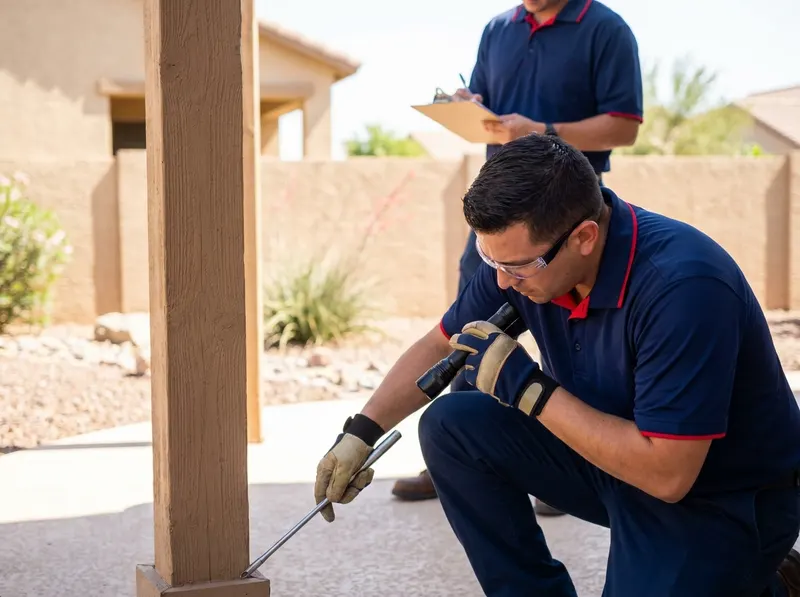
A termite inspection in Phoenix walks the full accessible perimeter, garage, patio slab edges, plumbing penetrations, stem walls, attic access and any crawl or storage area, then documents findings in writing — active tubes, old inactive damage, moisture conditions and conducive landscaping contact. Inspections cluster around real-estate closings and after winter rains, so allow one to two weeks of lead time during peak spring and summer home-sale months in Maricopa County. The report states what was seen and what was not accessible, because a clean file is only useful if it is honest. Bring it to your lender, HOA or buyer's agent as-is.
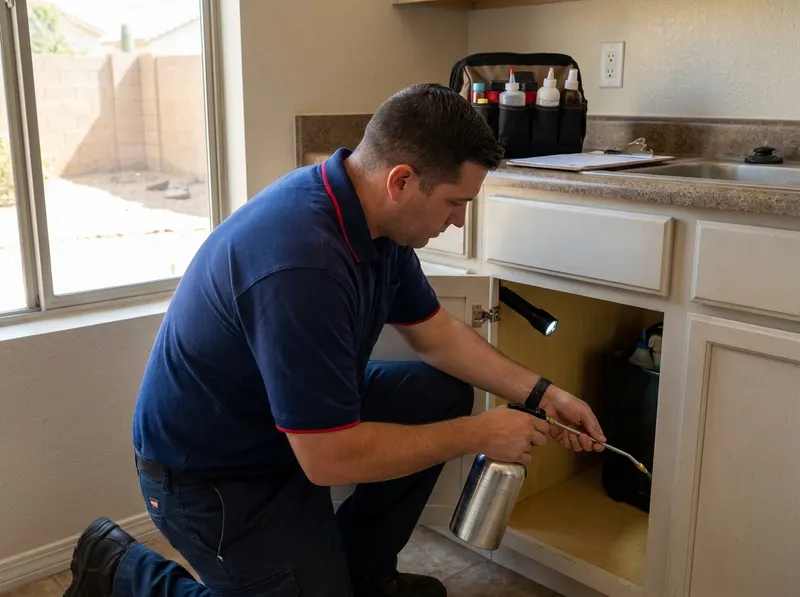
German roach work in a Phoenix kitchen is a two-visit minimum, not a fogging. Treatment targets the places they actually breed: cabinet hinges and corners, the dishwasher and refrigerator motor bays, under-sink plumbing, the toe-kick void, appliance seams and any cardboard storage. Eggs hatch on a two-to-four-week cycle, so a follow-up at three to four weeks is what breaks the generation rather than thinning it. Small tan roaches with two dark stripes behind the head are German roaches; large dark ones on the garage floor are not, and they need a different plan. Apartments and rentals often need adjoining units addressed to hold the result.
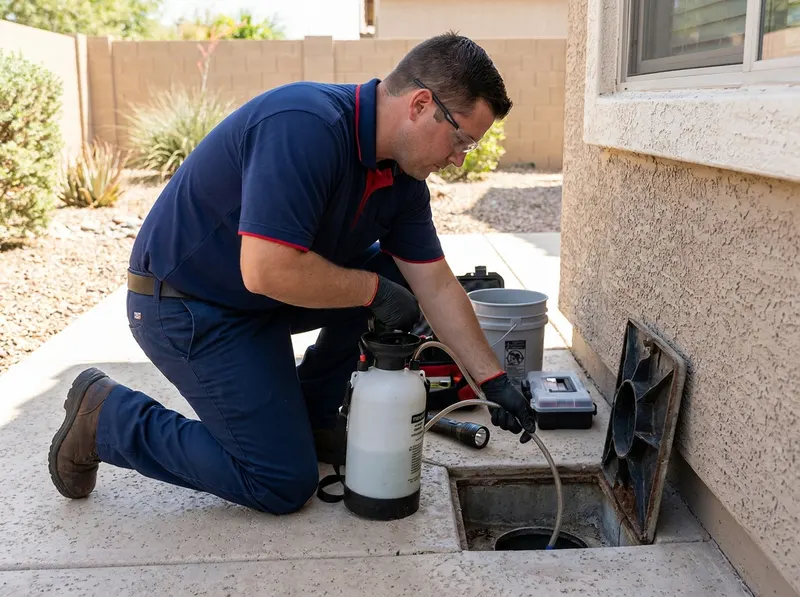
American roaches — the big dark ones Phoenix residents call sewer roaches — live in sewer lines, irrigation boxes, storm drains and damp block-wall voids, and they enter houses through floor drains, dry P-traps, garage doors and weep holes. Service is mostly exterior and drain-focused: perimeter and harborage treatment, irrigation and utility box checks, drain-line treatment and identifying which entry point they are using. Numbers spike after monsoon storms flood the lines they occupy, which is why mid-June to late September is the busiest stretch. Interior spraying alone rarely holds, because the population is not living inside the house.
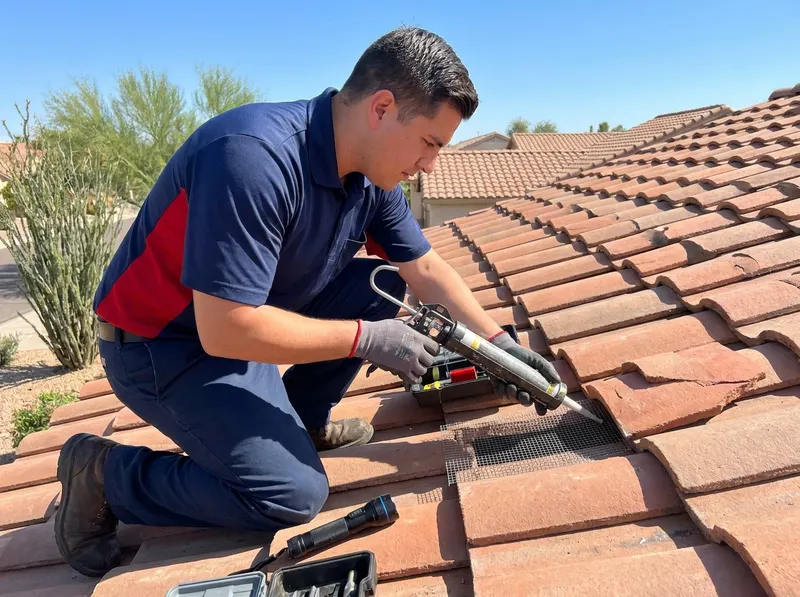
Roof rats travel above ground in Phoenix — along block walls, through citrus and ficus canopy, and onto tile roofs, then into attics through tile gaps, vent screens and roof-to-wall junctions. Service starts with a roof and attic inspection to find the actual entry, then trapping to remove the current animals and sealing to end the route. Reports concentrate in fall and winter in older irrigated central-Phoenix neighborhoods with mature canopy and dropped fruit. Trapping without sealing buys a quiet few weeks; sealing without trapping shuts animals inside. Both together is the version that ends it, and tree clearance from the roofline matters.
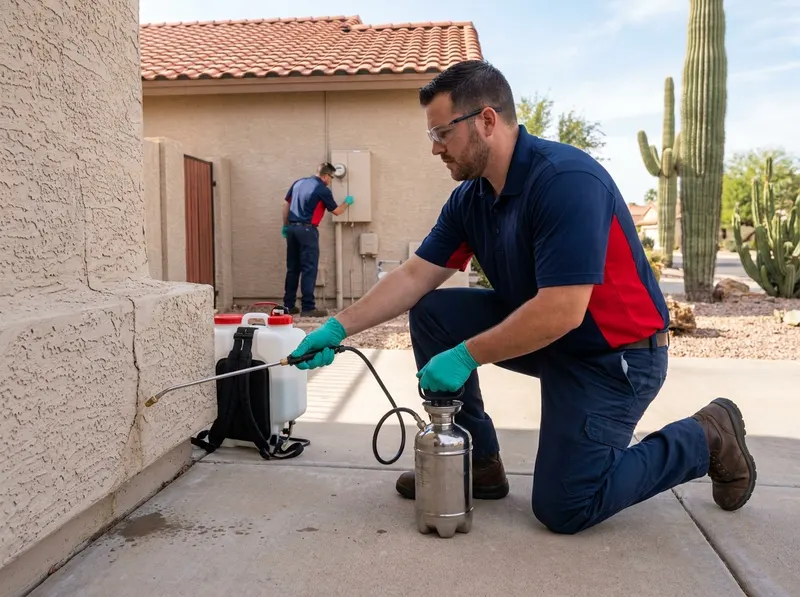
Black widows in Phoenix sit in dark, undisturbed voids close to the ground: block-wall weep holes, irrigation and valve boxes, meter boxes, pool equipment pads, patio furniture undersides, garage corners and the underside of BBQ islands. Treatment goes directly into those voids and knocks down webbing and egg sacs, because a widow rarely leaves her web and surface spraying past her misses her entirely. The messy tangled web at ankle height is the identifier, not a neat orb web. Cleaning stored clutter off block walls and off garage floors keeps the result longer, and that gets pointed out during the walk.
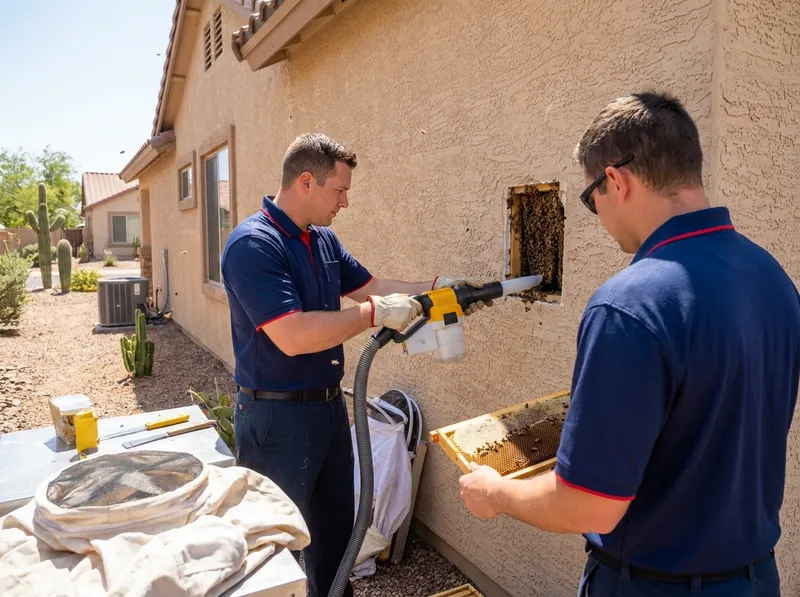
Honey bee colonies inside a Phoenix wall, roof cavity, chimney or block wall require opening the cavity and removing the comb, not just killing the bees. Left-behind comb melts in summer heat, stains drywall, and draws robbing bees and other insects back to the same void within weeks. Removal covers locating the cavity, opening it, taking out comb and brood, treating the void and closing the opening. Established swarms and colonies are most common from spring through early summer. Bees on a branch or fence in a loose cluster are a swarm and are handled differently than a colony that has already built comb in a structure.
Paper wasp and mud dauber nests on Phoenix homes hang under eaves, patio roofs, ramadas, pergolas, doorway soffits, playground equipment and block-wall caps. Accessible nests are treated and physically removed the same visit, and the surrounding surface is treated so the site is less attractive for rebuild — wasps return to proven locations. Activity builds through spring and stays high until overnight temperatures drop in late fall. High or hidden nests in soffit voids and attic vents get evaluated before anyone gets on a ladder over concrete. If the insect is fuzzy and gold rather than smooth and yellow-black, it is likely a bee and the plan changes.
Cricket numbers in Phoenix surge after monsoon storms and around irrigation cycles, and they matter for two reasons: the noise, and the fact that crickets are a primary food source for scorpions. Cutting cricket pressure around a foundation lowers the reason scorpions are hunting there in the first place. Service treats perimeter, block-wall bases, landscape rock, irrigation boxes, garage thresholds and doorway lighting areas, and includes a look at exterior lighting, because bright white fixtures pull crickets in from the whole yard. Homes backing to washes, parks or greenbelts near Papago Park and the Rio Salado Habitat Restoration Area see the heaviest late-summer waves.
Recurring exterior service in Phoenix keeps a treated barrier in place through the hot half of the year: bi-monthly is six visits, quarterly is four. Each visit re-treats the perimeter, weep screeds, block-wall bases, eaves, garage threshold, irrigation and utility boxes, knocks down webbing, and notes anything new in writing so you can see the trend rather than a receipt. Interior work is done on request only, since most desert pests are coming from outside. Bi-monthly makes sense in scorpion-heavy areas and desert-edge lots; quarterly is usually enough for general ant, cricket, spider and roach pressure in interior neighborhoods.
The right choice depends on which pest you have and whether you want the problem quieted or the population actually pushed down. If you found one scorpion and want to know whether there are more, start with a single inspection-led initial service: interior cracks, closets, bathrooms, weep screeds along the stucco line, garage thresholds, the water heater closet, pool equipment pad and the base of the block wall all get checked and treated, and you get a written record of where activity showed up. If scorpions keep appearing week after week — especially in Ahwatukee Foothills, Arcadia or homes along the desert edge near South Mountain Park and Preserve or Piestewa Peak — choose recurring exterior service instead: bi-monthly is six visits a year, quarterly is four. The trade-off is real money over twelve months versus a single visit that usually holds six to eight weeks in scorpion territory before the neighboring wall cavity refills the yard. Bark scorpions climb stucco, walk upside down under a roof line, and pass gaps narrower than a sixteenth of an inch, so the visits that matter most are the ones paired with sealing. That leads to the second decision: spray or seal. If you want fast knockdown on what is currently active, treatment does that. If you want fewer scorpions inside the house permanently, exclusion does more than any product — weep screed screening, door sweeps, garage corner gaps, plumbing penetrations under sinks, and the gap where a patio roof meets stucco. <strong>Sealing the building is the only part of scorpion work that keeps paying you back after the chemical has broken down in the sun.</strong> The trade-off is that exclusion is slower, priced by the amount of gap found, and does nothing about the scorpions already inside a wall — which is why the two are done together, not instead of each other. A useful way to split the budget: if the house is newer stem-wall stucco in Desert Ridge or Deer Valley with tight doors, treatment carries most of the load; if it is a 1950s block home in Maryvale or Coronado Historic District with original sweeps and open weep screeds, the sealing side deserves the larger share. Does one visit fix roaches? Not German roaches. A single kitchen treatment knocks the visible population back, but eggs hatch on a two-to-four-week cycle, so a first service plus one follow-up at three to four weeks is what actually clears a kitchen; American or "sewer" roaches coming up drains and through garage doors after storm runoff are usually an exterior and drain-line problem instead, and often resolve with exterior service alone. Why do roaches surge after monsoon rain in Phoenix? Storm water floods the sewer and irrigation lines they live in, and they move up and out — which is why call volume peaks between mid-June and late September. If you are seeing small tan roaches on cabinet hinges and near the dishwasher, that is the German roach path and it needs interior work; if you are seeing large dark roaches on the garage floor or bathroom tile after dark, that is the exterior and drain path and interior spraying is mostly wasted. For termites, the choice is scope. If an inspection finds mud tubes at one garage baseboard or a single patio pier and the rest of the foundation is clean, a localized treatment fits and costs a fraction of a full job. If tubes show at multiple points, if the slab sits on a flood-irrigated lot in Encanto-Palmcroft or Willo Historic District, or if you are trying to close a sale and want the file clean, a full perimeter trench-and-treat barrier is the durable answer. The trade-off is $650–$1,600 for a spot treatment that protects one area versus $1,400–$3,500 for a barrier that treats the whole footprint. Drywood termites are a different animal — they live in the wood, not the soil, so soil barriers do nothing and treatment is localized to the infested member. If you are on a real-estate timeline, order the inspection first and decide scope from the report rather than guessing from a photo. For roof rats, trapping alone gives you a quiet attic for a few weeks; exclusion — sealing roof-tile gaps, vent screens, and the citrus-to-roof path — is what ends it. If you want the noise stopped tonight, start with trapping. If you want it over, budget for both, and expect the tree-trimming and fruit cleanup to be part of the fix. For stinging insects, the split is simple: an accessible paper wasp nest under an eave is a same-visit removal, while a honey bee colony inside a wall or roof cavity requires opening the cavity and removing comb, because leaving comb behind draws robbing bees and stains drywall. Not sure which you have? Text a photo to (520) 677-4082 and you will be told which category it falls into before you spend anything.
| Service call | Upfront quote |
Your exact price is confirmed before any work begins.