
Subterranean Termite Treatment in Phoenix, AZ
- Pest Control Service in Phoenix
- Bark Scorpion Control
- Scorpion Exclusion and Sealing
- Drywood Termite Treatment
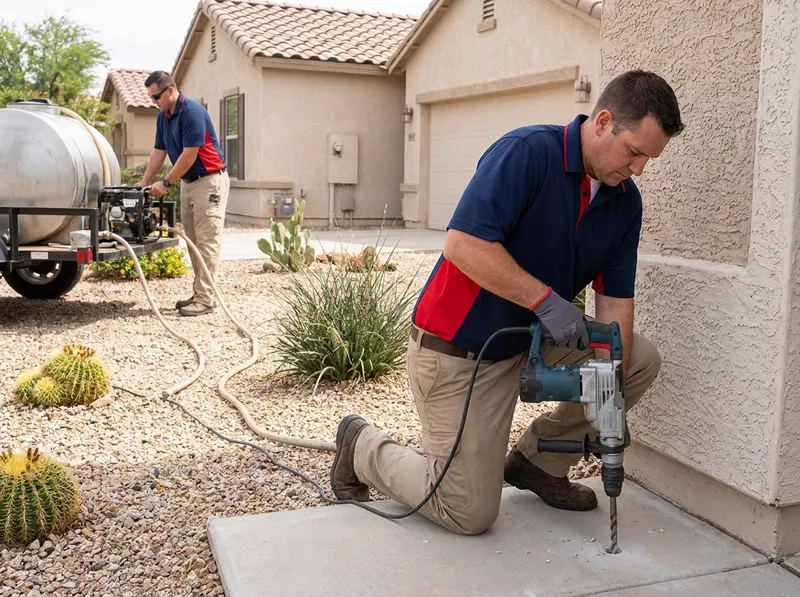
- Included: a full interior and exterior inspection for mud tubes and drop tubes, trenching and rodding of accessible soil along foundation walls, drilling and injection through slab or patio concrete where needed, and a written treatment record showing product used, dilution, gallons applied and every location treated.
- Timing: most Phoenix homes are inspected and treated in one visit of two to five hours; foraging activity typically drops off over the following two to six weeks as termites contact the treated soil.
- Cost: subterranean termite treatment in Phoenix generally runs $250 to $2,500 depending on linear footage, slab drilling and access — our minimum charge for any termite service is $250, and the exact figure is confirmed on a free on-site inspection.
- What we take: card, check or bank transfer, due once the treatment is finished and the documentation is handed over.
- Booking: call or text (520) 677-4082 with your neighborhood and what you're seeing — mud tubes on the garage baseboard, dirt lines up the stucco, or swarmers after a monsoon storm — and we'll schedule the inspection.
Desert subterranean termites live in the soil and travel up into a house inside pencil-thin mud tubes, so the treatment has to go where they live. <strong>A liquid soil treatment builds a continuous treated zone around the foundation, which is why access drives the price more than the size of the house.</strong> On a flood-irrigated lot in Arcadia or on the older Laveen parcels, soil moisture stays high most of the year and foraging pressure is constant, so we pay close attention to irrigation basins, tree wells and the wet side of the slab. In Maryvale, mud tubes often run up inside the hollow cores of block walls and only show themselves where the block meets the garage floor — those walls get drilled and injected rather than trenched. In Willo Historic District, Coronado Historic District and Encanto-Palmcroft, shallow original footings, added-on porch slabs and old expansion joints give termites more entry seams than a modern home has, and each seam has to be treated individually. Around Sunnyslope and parts of Ahwatukee Foothills near South Mountain Park and Preserve, caliche layers slow rodding down and change how the product is placed.
The main decision is liquid soil treatment versus an in-ground bait system. <strong>Liquid termiticide works fast and is the better fit when there is active damage, a signed contract, or an HOA or lender deadline.</strong> It does require drilling through concrete — patios, garage floors, sometimes interior slab at a bath trap. Bait systems avoid drilling and work well where a slab cannot be safely penetrated: many Desert Ridge and Deer Valley homes sit on post-tension slabs where cables must be located before any bit touches concrete, and monitoring stations are often the cleaner answer there. The trade-off is time. Baiting works through colony foraging and elimination can take months, with scheduled station checks in between. Liquid is faster and more finite; bait is slower and ongoing.
Subterranean treatment is also different from drywood termite work, and mixing them up wastes money. Drywood termites live inside the wood itself and need localized wood treatment or fumigation. <strong>If the tubes are made of soil and connect to the ground, the problem is subterranean and belongs in the soil treatment category.</strong> Swarmer flights in Phoenix usually follow the first heavy monsoon rains and happen in the evening, so a pile of wings on a windowsill after a July or August storm is worth an inspection even if you never see a tube.
Honest limits: a soil treatment protects the treated zone and does not reach termites already inside a wall void, so we treat those points directly during the same visit. Untreated gaps — a new patio pour, a landscape trench cut through the treated soil, a leaking hose bib — can create a bridge later, and we point those out in writing so you know what to watch. <strong>Every treatment is documented with product, rate and locations, which is what a buyer, agent or lender will actually ask for.</strong> Termite work in Arizona is a regulated activity and treatment records matter; keep your copy with the house file. Call (520) 677-4082 for a free on-site inspection anywhere in Maricopa County, from Papago Park east to Camelback Mountain and south past the Rio Salado Habitat Restoration Area.
Call (520) 677-4082Subterranean Termite Treatment pricing in Phoenix
| Inspection and written findings (mud tubes, damage, entry points) | Free on-site |
| Localized spot treatment — one wall, garage baseboard or bath trap | $250 - $500 |
| Partial perimeter treatment (one or two elevations) | $500 - $1,000 |
| Full perimeter liquid soil treatment, typical single-story Phoenix home | $950 - $1,800 |
| Full perimeter with extensive slab, patio or block-wall drilling | $1,500 - $2,500 |
| In-ground bait station system installation (post-tension slabs, no-drill situations) | $1,200 - $2,200 |
| Bait station monitoring visit | $250 - $400 |
| Re-inspection and treatment documentation for a home sale file | $250 - $450 |
Exact price confirmed free on-site before any work.
Subterranean Termite Treatment — questions, answered
How much does subterranean termite treatment cost in Phoenix?
Most subterranean termite treatments in Phoenix fall between $250 and $2,500. A localized spot treatment on a single garage wall sits near the $250 minimum; a full perimeter treatment on a home that needs patio and garage-floor drilling sits at the upper end. Linear footage of foundation and how much concrete must be drilled are the two biggest cost drivers, and the exact price is confirmed after the free on-site inspection.
Do you have to drill my slab to treat subterranean termites in Phoenix?
Drilling is needed wherever concrete covers soil that must be treated — which in Phoenix commonly means patio slabs, garage floors and sometimes an interior bath trap. Where the slab is post-tension, as it is on many Desert Ridge and Deer Valley homes, cable locations are checked first, and an in-ground bait system is often used instead so no concrete is penetrated. Drill holes are patched after injection.