
Honey Bee Colony Removal in Phoenix, AZ
- Pest Control Service in Phoenix
- Bark Scorpion Control
- Scorpion Exclusion and Sealing
- Subterranean Termite Treatment
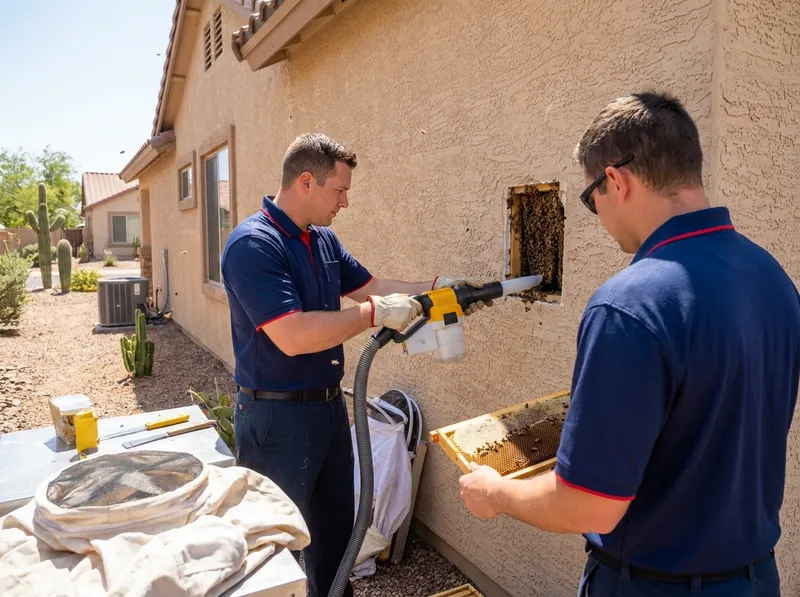
- Included: colony location and cavity assessment, bee removal, comb and honey cleanout where the void can be opened, treatment of the residual cavity, and sealing or screening of the entry point.
- Speed: active-colony and stinging-risk calls in Phoenix are prioritized; exposed swarms are usually a single short visit, while a wall or roof cutout is scheduled as a half-day job.
- Cost: exposed swarm removal in Phoenix starts at $250; structural colony removals with comb extraction typically run $450–$1,500 depending on access and cavity size.
- What we handle: honey bee swarms and established colonies in stucco walls, roof tiles and soffits, chimneys, block walls, water meter and irrigation valve boxes, sheds, and saguaro or tree cavities.
- Booking: call (520) 677-4082 with the location and how long bees have been present; a free on-site visit confirms the exact scope and price before any work starts.
The decision that drives everything is swarm versus established colony. A swarm is a clustered, in-transit group with no comb yet — often hanging off a mesquite limb, a patio beam or a citrus tree in Arcadia during the February-to-May bloom — and it can be removed cleanly the same day. Once bees have been inside a cavity two to three weeks, there is comb, brood and honey, and removal becomes carpentry as much as pest work. Leaving comb behind is the mistake that creates the second problem: unattended honey ferments in Phoenix wall temperatures, stains drywall, seeps through stucco, and the residual scent draws the next passing swarm to the exact same weep screed. <strong>Bee removal without comb removal is a temporary fix.</strong>
Phoenix construction gives colonies a short list of favorite addresses. Stucco-over-frame homes in Desert Ridge and Deer Valley let bees in through weep screeds, gable vents and gaps under tile at the roofline. Block-wall cavities in Maryvale, Laveen and Ahwatukee Foothills are entered through a single chipped or unmortared cell, and the colony builds down inside the cores where nothing is visible from outside. Older housing stock in the Willo Historic District, Encanto-Palmcroft and the Coronado Historic District brings unused chimneys, attic knee walls and detached garages into play. Flood-irrigated yards near Encanto Park also mean irrigation valve boxes and water meter boxes — a small, shallow cavity that is genuinely easy and inexpensive to clear. Along the desert edges by South Mountain Park and Preserve, Papago Park, Camelback Mountain and Piestewa Peak, colonies also use rock crevices, saguaro boots and abandoned rodent burrows; those are wild-habitat colonies, and if they are not against a structure or a walkway, the honest answer is often to leave them alone.
Here are the limits, stated plainly. <strong>Live relocation is not always appropriate in Maricopa County</strong>, because defensive Africanized colonies are not suitable for hobby apiaries; when a colony has stung people or pets, or sits at a doorway, school-route sidewalk or pool deck, the safe outcome is removal rather than rehoming. Access controls cost more than colony size does — a valve box is straightforward, a second-story soffit above a tiled roof is not. We open what can be opened safely and document the cavity; drywall patching, stucco repair and re-tiling are separate trades unless quoted otherwise. Expect returning foragers for a day or two after the hive is out, which is normal and thins quickly once the entry is sealed.
Safety around family is the question most Phoenix homeowners ask before price. Work is scheduled for cooler hours when flight activity is lower, the treated cavity is sealed rather than left open, and you will be told which rooms, patio areas and garden beds to stay out of and for how long. There is no year-long agreement attached to a bee job — a colony removal is a one-time, defined piece of work with a documented before-and-after. Prices below are ballparks based on typical Phoenix jobs; the exact figure is confirmed at the free on-site visit, after we find the actual entry and estimate the void.
Call (520) 677-4082Honey Bee Colony Removal pricing in Phoenix
| Exposed swarm removal — tree, shrub, patio beam or vehicle (minimum charge) | $250–$375 |
| Colony in irrigation valve box, water meter box or ground cavity | $275–$500 |
| Block-wall or pilaster colony — core opened, comb removed, cell sealed | $350–$750 |
| Stucco or frame wall-void cutout with full comb and honey cleanout | $550–$1,200 |
| Roof tile, soffit, gable-vent or second-story colony (access/ladder work) | $700–$1,500 |
| Chimney or attic knee-wall colony in older Phoenix housing stock | $650–$1,400 |
| Entry-point sealing and screening of additional gaps after removal | $250–$300 |
| Return visit for residual foragers or a second cavity found on site | From $250 |
Exact price confirmed free on-site before any work.
Honey Bee Colony Removal — questions, answered
How fast can you remove a honey bee colony in Phoenix?
Stinging-risk calls in Phoenix are prioritized, and an exposed swarm is often handled the day it is reported. A structural colony inside a wall, roof or chimney is scheduled as a half-day job once we have seen the entry point, because opening and cleaning the cavity takes longer than the bee removal itself. Call (520) 677-4082 with the location and how long the bees have been active.
Are the bees in my Phoenix wall Africanized?
Feral honey bee colonies in Phoenix and the wider Maricopa County area are treated as Africanized until proven otherwise, because Africanized genetics are widespread in established wild colonies here. Practically, that means the colony is approached as defensive: cooler-hour scheduling, protective equipment, and no attempt to agitate the hive to see how it reacts. It also means relocation to a hobby hive is frequently not an appropriate outcome.
Do you relocate honey bees instead of killing them in Phoenix?
Exposed swarms in Phoenix are the best candidates for live capture, since they carry no comb and have not yet established a defensive nest site. Established colonies inside a structure — especially any that have already stung people or pets near a door, pool or walkway in neighborhoods like Arcadia or Ahwatukee Foothills — are usually removed rather than rehomed, because defensive stock is not safe to place in a managed apiary. We tell you which situation you have before work begins.
Why does the comb have to come out of a Phoenix wall void?
Comb left inside a Phoenix wall holds honey that ferments in high wall-cavity temperatures, then stains drywall, seeps through stucco and attracts roaches, ants and other scavengers. The residual beeswax scent also acts as a marker that draws the next swarm to the same weep screed or block-wall cell. Removing comb and sealing the entry is what turns a bee call into a solved problem rather than a repeat one.
How much does honey bee colony removal cost in Phoenix?
Honey bee colony removal in Phoenix starts at a $250 minimum for a reachable exposed swarm, with structural removals that require opening a wall, roof or chimney typically landing between $450 and $1,500. Access drives the number more than colony size does — a ground-level irrigation valve box in Laveen is inexpensive, while a second-story soffit in Desert Ridge is not. Every figure is a market-range ballpark, and the exact price is confirmed at a free on-site visit.